05 - Food

How to Eat in Georgia

12 culinary regions. One central principle: never rush.

Georgia has twelve distinct regional cuisines. Each region has its own dishes, its own flavors, its own approach to the table. The further you travel from Tbilisi, the more specific and locally proud the food becomes.

Georgian food is organized into two broad families: Western Georgian cuisine and Eastern Georgian cuisine. The difference is real and worth understanding.

Western Georgia

Spicier. More walnut. More poultry. More corn. Influenced by proximity to the Black Sea and centuries of different trade routes.

Eastern Georgia

Heavier on meat and bread. Wine country cuisine. The influence of the steppe and of Persia. Where khinkali comes from.
Western Georgia

The Western Table

Samegrelo

The homeland of serious heat. Megrelian cuisine uses more spice and more walnut than anywhere else. Famous for Megrelian ajika (the real thing - a paste, not a sauce), elarji (cornmeal with cheese pulled through it), and gebzhalia (cheese stuffed with mint in a warm milk sauce). If something is labeled Megrelian, expect intensity.

Imereti

The most widely found Georgian cuisine outside of Georgia. Imeretian khachapuri - round, flat, filled with fresh Imeruli cheese - is the version you'll see everywhere. Also known for a huge variety of pkhali (cold vegetable pates), chqinti (fresh young cheese), and clean, unfussy flavors.

Adjara

The coastal region on the Black Sea. Adjarian cuisine is dairy-heavy and extremely satisfying. The Adjarian khachapuri (an open boat of dough filled with cheese, topped with an egg and butter) is an experience, not just a dish. Also look for borano (fried cheese with butter) and sinori (thin rolled dough in cheese and cream).

Guria

The green region west of Adjara. Known for poultry dishes, sacivi (chicken or turkey in a rich walnut sauce, served cold - it sounds wrong and tastes extraordinary), and the Gurian pie: a khachapuri variant stuffed with cheese and boiled eggs.

Svaneti

High mountain cuisine. Hearty, simple, built for altitude. Kubdari (a meat and spice-filled bread baked in the fire) and chvishtari (cornbread with cheese) are the things to look for.

Racha-Lechkhumi

A small forested region between the mountains. Racha ham is famous enough that people bring it home as a gift. Shkmeruli (chicken cooked in a white garlic and cream sauce) and lobiani (bread stuffed with spiced beans) are the dishes to know.

Abkhazia

Heavy on ajika, corn, and walnut. Famous for abista (a polenta-like dish), apkhazura (meat-filled sausages), and a version of cuisine that has its own distinct identity separate from the rest of Georgia.

Eastern Georgia

The Eastern Table

Kakheti

The heartland of Georgian winemaking. Kakhetian cuisine is built around the barbecue - mtsvadi (skewered pork or beef grilled over a vine-wood fire) is a way of life here. Also khashlama (slow-boiled meat and vegetables), chakapuli (spring lamb stew with tarragon and white wine), and the Kakhetian salad you should not miss: cucumber and tomato with sunflower oil. Not olive oil. Sunflower. The difference is everything.

Kartli

A diverse region in central Georgia. Kartli cuisine ranges from hearty soups to elegant dishes. Chikhirtma - a rich, egg-thickened soup made with chicken or lamb - is reportedly very effective for hangovers. You may want to remember this.

Mntianeti (Pshav-Khevsureti / Mtiuleti)

The mountain highlands. This is where khinkali comes from - the original, the real thing, made by hands that have been making it the same way for centuries. Also khavitsi (a simple butter and flour dish), and dambalkhacho: a fermented, aged cheese that smells like a very strong argument and tastes incredible.

Tusheti

A remote mountain region accessible only in summer. Tushtian guda cheese is one of the most distinctive cheeses in the country - made in a sheepskin bag, aged in its own natural environment. You may not find it everywhere, but if you see it, try it.

Samtskhe-Javakheti (Meskheti)

Sofi's Region

This is Sofi's region. One of the most unique culinary corners of Georgia, and genuinely underrepresented in the rest of the country.

Known for tenili cheese - a pulled, braided cheese that is unlike anything else.

Apokhti - dried goose meat. You either love it immediately or need a few bites to understand it. Either way, try it.

There is a tradition of cooking snails here. Yes, really. They are earthy and good.

And then there is Guliani Kada - a flaky, layered pastry khachapuri. Not the sweet version. The savory one. This is important. Do not confuse them.

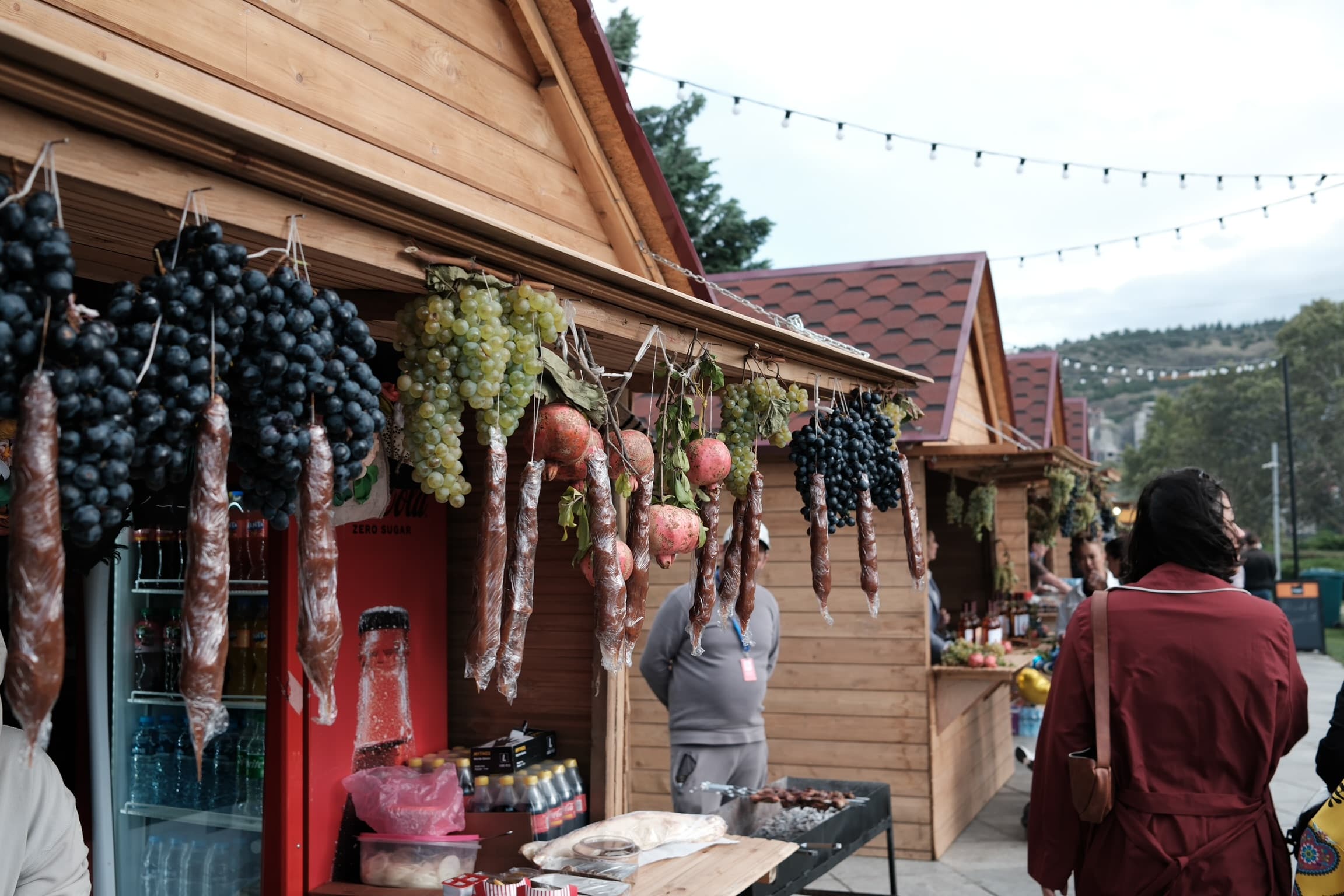
Georgian market - grapes, pomegranates, and churchkhela hanging at a Rtveli festival stall

Rtveli Festival · Kakheti · September · Photo: Liam

The Dishes

The rules

Khinkali

Khinkali are soup dumplings. Giant, pleated, filled with meat and broth. They are the most debated thing in Georgian cuisine and there are rules.

01

Pick it up by the knot. The knot is your handle.

02

Do not use a fork. That is the whole point.

03

Bite a small hole in the side. Drink the broth first. This is not optional - it is the best part.

04

Do not eat the knot itself. It is how people count how many you had. It is also just dough.

05

Count your dumplings. It becomes competitive. This is fine and encouraged.

A Brief Guide to Khachapuri

Khachapuri means cheese bread. But there are many kinds of cheese bread, and knowing the difference matters.

Georgia also has over 60 unique types of cheese - most of them you will never encounter outside the country. Read about them here.

Hosts' Favorites

Imeretian

The round one

The most common. A round flatbread with fresh Imeruli cheese inside. The standard. Excellent. The baseline.

Adjarian (Acharuli)

The boat

An open boat of bread dough filled with cheese, with an egg cracked on top and butter added while it's still hot. You stir it all together. You eat it from the bread itself. It is overwhelming in a very good way. Order this.

Penovani

The flaky triangle

Made from a layered, flaky puff-pastry style dough. Often triangular. The texture is completely different - almost like a savoury pastry. This is Sofi's favorite from Machakhela.

Qada

The Meskheti one

A flaky, layered pastry from Samtskhe-Javakheti filled with savory cheese - not to be confused with the sweet version. Crispy outside, soft inside. Genuinely underrepresented. Almost impossible to find outside the region.

Lagidze Limonade

In 1887, a pharmacist named Mitrofan Lagidze began experimenting with flavored water syrups in Tbilisi. He developed a range of concentrated natural syrups - extracted from real fruits, herbs, and plants - and mixed them with sparkling mineral water. Lagidze Water became the official drink of the Romanov royal family. It was served at the 1945 Yalta Conference. It outlasted the Soviet Union.

Many places we recommended have Lagidze Limonade. Next best thing is Natakhtari Limonade and it has all the same flavours.

Churchkhela

Walnut halves threaded on a string, dipped in a thickened grape-juice mixture, hung to dry. The result looks like a very dark, dense candle. It tastes like nothing quite like itself - chewy, grape-sweet, nutty, slightly tannic from the must. You will see it sold everywhere.

If you are trying it from somewhere other than Badagi - at least get classic Churchkhela made from actual grape juice. Please do not eat the green or red ones.

The way to eat here

In Georgia you go to places to hang out and spend hours talking and loving life with friends and family. When you go out, take your time. Nobody expects you to rush. Have an adventure.

Share everything. Order too much. Don't plan the last dish before you've eaten the first one.

The table will keep offering you things. Accept most of them.