04 - Tbilisi

თბილისი

Tbilisi

The mythology layer

A king. A falcon. A pheasant. A hot spring in the middle of a forest. This is how a capital city got its name.

The founding

Bedtime Legend About Tbilisi

Vakhtang Gorgasali was hunting.

His falcon was chasing a pheasant. The pheasant fell into something warm - a thermal spring, steaming quietly in the middle of a forest - and never came out. The king walked over and found the bird cooked. The water was boiling up from somewhere underground.

He looked at that place and understood something.

He called it Tbilisi. In Georgian, tbili means warm. The hot water was already there, rising from the earth. The city just grew around it.

That was the 5th century. More or less.
1,500 years later

Those thermal springs Vakhtang found are still there.

The Abanotubani district - which translates roughly as "bathhouse district" - is a cluster of domed brick buildings sitting over the same underground springs. You go in. You sweat. You get scrubbed by someone who takes their job extremely seriously. You come out a completely different version of yourself. Slightly dazed. Completely clean.

Alexander Dumas visited the baths in 1858 and declared them the best bath he had ever taken. He was quite a traveler. This is worth noting.

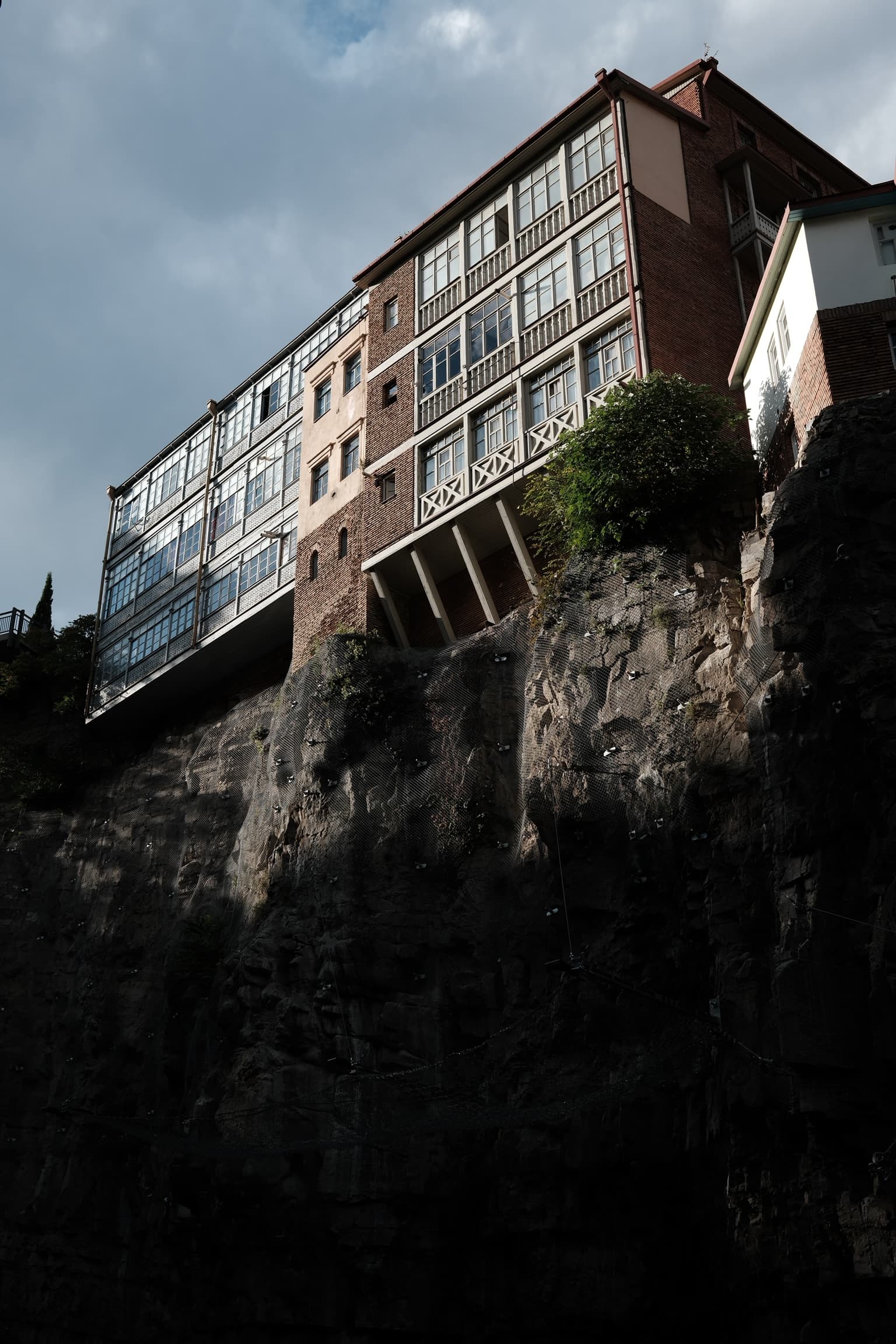
Tbilisi old town - building perched on the cliff above the Narikala river

Kala District · Old Town · Tbilisi

The Balconies

Walk through Narikala (ნარიყალა) and Abanotubani. Right next to the sulfur baths there is a walking path that slowly starts climbing into the hills. Follow it. Eventually you will find yourself at the edge of a park with a waterfall.

Look around while walking.

The carved wooden balconies are one of the most recognizable details of Old Tbilisi - decorative balustrades hanging over narrow streets, painted in faded colors, sometimes structurally questionable, always beautiful. They are part of the city's UNESCO-recognized historic identity and one of the reasons Tbilisi feels so visually distinct.

Some are carefully restored. Others feel like they are surviving purely through stubbornness and old wood.

That contrast is part of the charm.

Mtatsminda

Skip the rooftop bars for a moment. Take the funicular cable train. We linked the location for you.

While you are up there, if you are hungry: get Ponchiki (Georgian-style doughnuts) and Lagidze Water at the restaurant. It is very 1980s in the best way.

Chronicles of Georgia

You need to drive there. It is worth it.

The Chronicles of Georgia is a monumental column structure on the outskirts of the city - sixteen enormous stone pillars carved with figures from Georgian history and mythology. It was started in the Soviet era, never officially finished, and has been sitting there ever since in a state of grand incompleteness that somehow suits it perfectly.

The scale is something you cannot quite prepare for. It sits above the Tbilisi reservoir with the city spread out behind it. Most tourists miss it. That is their loss.

A local habit

The Lakes

One of those things locals do constantly - morning, evening, late night - and whenever you arrive, the whole city seems to already be there. Not a destination. A habit.

Kus Tba (Turtle Lake)

The closer, smaller lake. Walkable from Vake neighborhood. People circle it at all hours - stopping to talk, sitting on the banks, letting the evening go wherever it goes. The city lights are below you.

View on Map

Google Maps

Lisis Tba (Lisi Lake)

Bigger. Better views. Further out. The whole city of Saburtalo and Vake seems to end up here on warm evenings. A full loop is about 3km and worth every minute.

View on Map

Google Maps

The character of the city

Tbilisi just exists - chaotic and warm and slightly crumbling at the edges - and lets you find the parts you respond to.

Some people love it immediately. Some people need a day before it lands. Almost no one leaves indifferent.